My Tree: A Creative Practice for Finding Support
If you were a tree, what kind of tree would you be today? What would help you stay rooted in the ground? And what would you need to grow and feel alive?
Sometimes, amid everyday concerns, we stop noticing how we are feeling. We keep completing tasks, answering messages and supporting others — and only occasionally ask ourselves: “How am I doing right now? What is supporting me?”
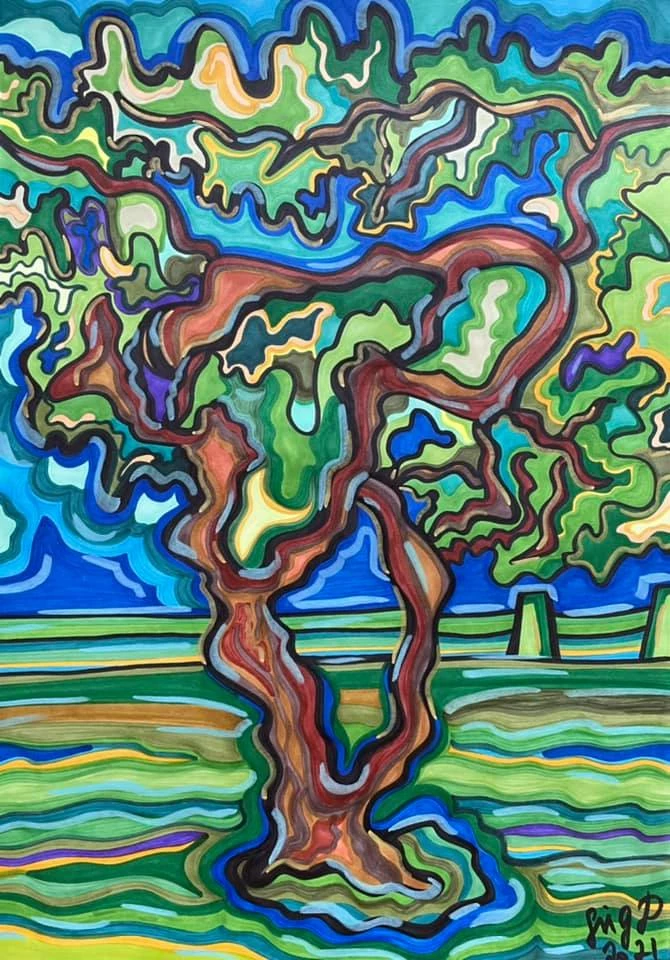
Let’s explore these questions through drawing. The image of a tree will become a metaphor for yourself and your life: a way to listen to your feelings, recognise your needs and look for available sources of support.
You do not need to know how to draw. What matters here is your attention and the meaning the image holds for you.
What you will need: a sheet of paper, pencils, felt-tip pens or paints, and around 20–30 minutes to spend with yourself.
A brief clarification: this is a creative practice for supporting yourself, incorporating elements of an art therapy approach. There is no need to decode the drawing using ready-made interpretations: the shape of the trunk, the colour of the leaves or the absence of roots do not, on their own, tell us anything about your character or psychological state.
1. Pause and feel supported
Make yourself comfortable. Place your feet on the floor or find another position in which your body feels supported. Notice the surface beneath you: the floor, the chair, the armchair.
If it feels comfortable, close your eyes. You can also keep them open and let your gaze rest on a point in front of you.
Notice your breathing. There is no need to change anything straight away. Take a few calm breaths at a comfortable pace, without forcing or holding your breath.
Allow your shoulders to drop a little. Relax your jaw and hands. You do not need to achieve complete relaxation — simply ease the effort a little wherever you can.
Feel how the surface beneath you holds the weight of your body. For now, you can let yourself lean into that support a little.
2. Imagine your roots
Imagine your legs gradually extending into the earth, like the roots of a tree. They spread outwards and downwards, finding space and support.
You do not need to picture this clearly. A thought, a sensation or a vague image is enough.
Imagine that these roots allow you to receive what you need to live. You do not have to hold everything together through your own efforts alone: there can be ground beneath you that supports you.
As you continue breathing calmly, ask yourself:
If I were a tree right now, what would I be like?
Do not rush to choose a beautiful, strong or “right” tree. Allow whatever image comes to you today to emerge.
Where does it grow? What season is it? What do its trunk, branches and crown look like? What surrounds it? Are there other trees nearby?
Your image may look nothing like a real tree. That is welcome too.
3. Draw your tree
When you are ready, open your eyes and bring the image onto the paper.
Do not spend too long thinking about composition or artistic quality. You can draw simple shapes, change colours, leave empty spaces or add words. Your tree does not need to enter the Tree of the Year competition. It is already beautiful just as it is.
Try to notice the process itself: which lines you feel like drawing, which materials you want to use and where you want to linger.
If no image comes to mind, start with any line. The tree may emerge as you draw. Trust yourself.
4. Ask: “Tree, what do you need?”
Put down your pencil and look at the drawing.
What feelings does it bring up? Do you like this tree? Do you feel like moving closer to it, protecting it or changing something? Perhaps you feel tenderness, sadness, irritation, calm — or nothing clearly defined yet.
If you do not like the tree or it seems vulnerable, try setting your judgement aside for a moment and approaching it with curiosity:
What is happening to you?
What are you missing?
What would help you feel more firmly rooted?
What do you need to grow and flourish?
Perhaps it needs water, light, more nourishing soil, space for its roots, shelter from the wind or the company of other trees. Perhaps it needs rest: a time when it does not have to blossom or bear fruit. Perhaps your tree needs other trees or flowers nearby — or an ice cream cart? Do not limit your imagination; allow your subconscious to express itself.
Listen to the associations that come to you. An answer might emerge as a word, a sensation, an image or an urge to add something to the drawing. If no answer comes yet, give yourself time.
If you already like your tree, you can ask a different question: “What supports you? How can I care for you even more?”
5. Add what offers support
You can now change the drawing, if you wish.
Draw what the tree needs: rain, sunshine, soil, a fence or other plants. Add colour or give it more space around it. If you feel like it, draw a new version on another sheet.
As you draw, ask yourself:
What is it like to give this tree what it needs?
What is changing in the way I relate to it?
How am I feeling right now?
6. Look at the drawing again
Once again, feel the surface beneath your feet and the support beneath your body. Take a few calm breaths in and out.
Look at your tree.
What do you feel now? Has anything changed in your body: tension, breathing, the position of your shoulders? What thoughts have emerged?
You do not have to feel relief. You may notice tiredness, sadness, mixed emotions or no change at all. This is also part of your experience today.
If the exercise becomes uncomfortable, you can stop, look around you and return to your usual activities. There is no need to force yourself to continue.
7. Bring the image into everyday life
Take another sheet of paper or a notebook and complete a few sentences:
-
Today, my tree…
-
It already receives support from…
-
It is missing…
-
When I added what it needed, I felt…
-
In my own life, this reminds me of…
-
One small step I can take to support myself is…
Try connecting the metaphor to something concrete. What does “water” mean to you: rest, sleep, creativity, a conversation? Who or what makes up your “soil”? What kind of protection do you need right now? Where would you like more space?
Choose one manageable step: ask for help, set aside time to rest, return to an activity you love, set a boundary or arrange to meet someone whose company helps you feel at ease.
You do not need to change your whole life at once. You can begin with one action that responds to the need you have noticed.
Can you do this together?
Yes. You can invite someone close to you to try the exercise, each draw your own tree, then share your impressions — if you both want to.
Let the person who made the drawing explain what it means to them. Instead of offering interpretations, try asking: “What would you like to tell me about your tree?” or “What kind of support does it need?”
You can also keep the drawing to yourself. A personal experience does not have to become a story you share with others.
What does science say?
Research gives us reasons to explore drawing as a way of supporting ourselves. In a small study by Kaimal and colleagues (2016), salivary cortisol levels were measured in 39 adults before and after 45 minutes of art-making. On average, levels decreased after the session. Beginning with calm breathing also has a scientific basis. A systematic review by Zaccaro and colleagues (2018) describes links between slow breathing, changes in autonomic nervous system regulation, and measures of relaxation and emotional state. However, the authors highlight differences between research methods and the need for more rigorous studies.
Here, the tree serves as a metaphor for reflection. The potential value of this practice lies in making room to pause, express your inner state through an image and ask yourself: “What kind of support do I need right now — and what can I offer myself or ask others for?”
If you need help finding your footing, book a consultation with a psychologist.